Showing posts with label Broadway adaptation. Show all posts
Showing posts with label Broadway adaptation. Show all posts
 |
| Deborah Kerr and Richard Burton |
"Don't make me take steps, Dr. Shannon ..." -- Judith Fellowes.
The former minister T. Lawrence Shannon (Richard Burton), who was locked out of his church, is now guiding ladies on a tour bus through Mexico. Young Charlotte Goodall (Sue Lyon) can't keep her hands off Shannon, inspiring the ire of her formidable guardian Judith Fellowes (Grayson Hall). Shannon takes the gals to a small hotel run by an old friend, Maxine Faulk (Ava Gardner), whose husband died a short while ago. While some of the tourist ladies put up a fuss, Maxine reluctantly admits the impoverished artist Hannah Jelkes (Deborah Kerr) and her aged poet father, Nonno (Cyril Delevanti) to her hostel. As these characters interact and Shannon faces dismissal from the tour business, will the man finally find himself "at the end of his rope," like one of the iguanas tied to the stairs? Like many Williams' adaptations The Night of the Iguana is a mix of the poetic and the pretentious, but it does have some very tender moments. Burton, Lyon and Delevanti walk off with the acting honors. Grayson hall [House of Dark Shadows] is a bit overwrought, almost ridiculous at times, as Judith, but the whole idea of the fire-breathing repressed lesbian is terribly dated. Deborah Kerr [Edward, My Son] is good, but she doesn't quite get across the weary defeatedness of someone who is a caregiver to a man in his nineties [walking him around Mexico in the heat with little money could almost be considered elder abuse], and is apparently homeless besides -- where is the sheer desperation she would be feeling? Gardner [Seven Days in May] is not bad at all and suitably earthy; Bette Davis played the role on the stage. The poem that Nonno completes, written by Williams, of course, is beautiful. Despite its flaws, the movie casts a certain exotic and haunting spell.
Verdict: Imperfect but entertaining and well-acted, with some interesting characters. ***.
 |
| Robert Ames and Vilma Banky |
"Of all the lowdown, dirty tricks that was ever played on a girl!"
A vintner named Tony (Edward G. Robinson) is smitten with a pretty foreign-born waitress, Lena (Vilma Banky), and sends her a proposal of marriage through the mail. Unfortunately he also encloses the photograph and of his younger and better-looking hand, Buck (Robert Ames), leading to sensual complications when Lena finally arrives in the Napa Valley. This is the second film version (and first sound picture) of Sidney Howard's They Knew What They Wanted and it has a slight edge over the 1940 film of that title, even though Robinson is not as good as Tony as Charles Laughton was. Robinson seems to play the character as if the film were a comedy, although he has some strong moments of poignant desperation at the end. Banky and Ames are fine, although Buck, who seems a decent enough sort, has a bit of a character reversal to bastard towards the end. The best version of this story might be Frank Loesser's The Most Happy Fella.
Verdict: Creditable adaptation with interesting cast. ***.
 |
| Katharine Hepburn and Paul Scofield |
A DELICATE BALANCE (1973). Director: Tony Richardson. Play by Edward Albee. AFT [American Film Theatre] production.
"I can't stand the selfishness. Those who want to die and take their whole lives to do it."
"I was not and never had been an alcoholic. I had nothing in common with them. They were sick. And I was merely willful."
Agnes (Katharine Hepburn) and Tobias (Paul Scofield of A Man for All Seasons) are a married couple who live in an upscale Connecticut community. Also living with them is Agnes' sister, Claire (Kate Reid of She Cried Murder). who has a "drinking problem" whether she wants to admit it or not, and is continuously berated by Agnes. The couple's daughter, Julie (Lee Remick of The Omen), is also coming home when it looks as if her fourth marriage is going to wind up on the rocks along with the first three. But the strangest house guests are Agnes and Toby's best friends, Harry (Joseph Cotten) and Edna (Betsy Blair), who come over to stay when they suffer a panic attack [over encroaching age, fear of death, fear of losing one another?] that absolutely terrifies them. They move into Julia's bedroom, but when she returns Julia is horrified to realize that her parents aren't going to ask them to leave. They are friends, yes, but she's their daughter. Yet Harry and Edna seem to think they have more right to the room than she has. This situation brings out all the tensions in the family (albeit most of them were out already) making the atmosphere even more poisonous... A Delicate Balance won Edward Albee a Pulitzer Prize -- although it was back in the days when most Pulitzers went to wealthy white guys like Albee. Albee isn't the first person to write about a dysfunctional family and others have done it better [for instance, this in no way compares to O'Neill's brilliant Long Day's Journey into Night]. If Delicate Balance has anything going for it it's some excellent -- if occasionally dated -- dialogue, but the people are perhaps more dreary than interesting. As with Albee's Who's Afraid of Virginia Woolfe the playwright resorts to black comedy -- and much of this is quite funny -- when all else fails. The characters (archetypes that border on stereotypes) are more obscure than well-developed, as if they were all people Albee knew but he isn't able to make them really come alive for anyone who didn't personally experience them. This is left for the actors to do, and they do their best, even if the casting isn't perfect. Hepburn and Scofield are quite good, Remick is fine, Reid quite intense, Cotten actually gives one of the best performances of his career, and Blair, while a cut below the others, has some excellent moments. The acting and situations hold your attention, but ultimately this is unsatisfying, and hardly a really great drama.
Verdict: A lot of talk, some of it interesting, that ultimately goes nowhere. **1/2.
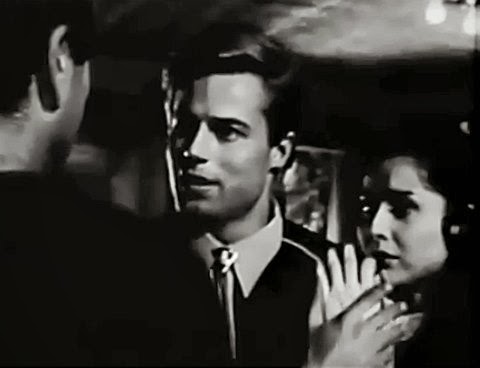 |
| Confused triangle: Vallone, Sorel and Lawrence |
A VIEW FROM THE BRIDGE (aka Vu du pont/1962). Director: Sidney Lumet.
NOTE: This review discusses important plot points. Eddie Carbone (Raf Vallone of The Other Side of Midnight), his wife Beatrice (Maureen Stapleton of Interiors), and their niece Catherine (Carol Lawrence) live together near the shipyards in Brooklyn. They take into their home two illegal immigrants, Marco (Raymond Pellegrin), who is older and married, and handsome young Rodolpho (Jean Sorel), who is immediately attracted to Catherine and vice versa. This doesn't sit well with Eddie, who has not slept with his wife in months, and who seems to be obsessed with his pretty niece. Eddie never misses an opportunity to cast doubt on Rodolpho's sexuality because he sings, has blond hair, and other ludicrous reasons, but primarily because he sees him as his rival -- or perhaps is attracted to him and must belittle him in classic closet case fashion. It all culminates in a scene when Eddie first kisses Catherine full on the lips, and then does the same to Rodolpho in a supposed attempt to expose his homosexuality [talk about doing things backwards!] And things become even more melodramatic after that... The main strength of this adaptation of Arthur Miller's play is the acting, which is excellent across the board, especially the performances of a passionate Vallone, sympathetic Stapleton, and lovely, confused Lawrence. Unfortunately, it's all a trifle over-baked and coy at the same time, a combination that doesn't work. The double-kiss probably played on the stage, but it's much more of a dramatic device than anything you can take seriously, almost the stuff of soap opera. Since it's hard to believe that this "macho" guy would want to give a hard smack to Rodolpho's lips if he were really straight, critics ever since have speculated on the possibility that Eddie is a repressed homosexual [and indeed with his homophobia and other acts one can see how it could be interpreted that way]. Was Miller afraid to tackle the subject head on when he wrote the play in the fifties, leaving that sort of thing to Tennessee Williams (who probably would have made a better play out of View) and using Catherine as a "beard?" The ambiguity gives the whole movie a dated air, although it does have some powerful moments.
Verdict: Interesting, with a wonderful lead performance, but just misses being really special. ***.