Showing posts with label romance. Show all posts
Showing posts with label romance. Show all posts
 |
| Sherwood (Otto Kruger) is in love with Letty (Madge Evans) |
BEAUTY FOR SALE (1933). Director: Richard Boleslawski.
"If he gives you a hat in only an hour imagine what he can do in three weeks."
Letty (Madge Evans) takes a room with the Merrick family, which consists of the mother (May Robson), her daughter Carol (Una Merkel), and son Bill (Eddie Nugent), who's stuck on Letty. Carol helps Letty get a job at the beauty parlor where she works, which is lorded over by the dragon-like Sonia (Hedda Hopper). Unlucky in love, Carol is keeping company with a wealthy, much older man named Freddy (Charley Grapewin). Their fellow employee, Jane (Florine McKinney), is having a secret relationship with Sonia's son, Burt (Phillips Holmes). Letty falls in love with a Mr. Sherwood (Otto Kruger), who happens to be married to one of the beauty spa's customers, the flighty and affected Henrietta (Alice Brady). Will any of these women find happiness? Well, maybe ... Beauty for Sale is a highly engaging comedy-drama with a very appealing lead performance by the luminescent Evans and excellent supporting performances from Merkel, McKinney, Brady and Kruger; the others, such as Hopper, are also well-cast. The movie blends its laughs [all the funny gossiping that goes on at the beauty parlor] and tragic moments expertly, and is well-directed by Boleslawski, who often favors extreme close-ups at tilted angles. There's a nice bit when a bathroom door slowly closes on the huddled figure of Jane after she gets some shattering news. Isabel Jewell [The Seventh Victim] is very sharp and saucy as the receptionist, Hortense, and Nugent scores as the likable but sadly immature Bill, who nearly drives Letty crazy [his mistreatment at her hands is sort of glossed over]. Boleslawski also directed the interesting Storm at Daybreak and Les Miserables.
Verdict: Minor classic is well worth the watching. ***.
 |
| Charles Farrell and Bette Davis |
THE BIG SHAKEDOWN (1934). Director: John Francis Dillon.
Jimmy Morrell (Charles Farrell) owns a neighborhood drug store and employs his sweetheart Norma (Bette Davis) behind the counter. Along comes smooth operator and racketeer Dutch Barnes (Ricardo Cortez), who discovers that Jimmy can make toothpaste just the same and just as good as the best-selling brand. Jimmy agrees to go to work making duplicate toothpaste and other stuff for Barnes, but he assumes they'll be marketed under a new brand name. Instead Barnes simply puts the bogus stuff into tubes with the label of the original brand on them and distributes them as the real thing. Jimmy is nervous about this development, but he keeps making fake toiletries and cosmetics for Barnes to distribute, until one day Barnes decides to duplicate a famous antiseptic -- only without the specific ingredient that makes it antiseptic -- and there are worse things to come. The Big Shakedown has a good premise and there are some dramatic developments, but the picture doesn't present them with any flair or intensity. Farrell is fine, but while Cortez plays the very suave and polished villain with his usual aplomb, it's also a distinctly superficial portrait. This was one of the thankless roles that Bette Davis -- top-billed with Farrell although she hasn't much to do -- was handed in the early days. She looks cute and is quite adept; Glenda Farrell has a somewhat larger role as a girlfriend of Barnes' who gets into a zesty hair-pulling match with Renee Whitney as her rival Mae LaRue. Perhaps the best thing in the picture is Barnes' flamboyant death scene, even if it doesn't make too much sense. Many years later Charles Farrell was Gale Storm's father on My Little Margie; he was not related to Glenda Farrell.
Verdict: This had possibilities but it's nearly a snooze. *1/2.
 |
| Barbara Stanwyck and Regis Toomey |
Kitty Lane (Barbara Stanwyck), a girl from the wrong side of the tracks, winds up as a waitress in a literally greasy spoon where she meets David Livingstone (Regis Toomey). David wants to marry Kitty, but his termagant, selfish mother (Clara Blandick) refuses to countenance the idea of her son, who's studying to be a doctor, marrying a common waitress, and trumps up charges against her with the aid of an odious judge friend [it's quite satisfying watching Toomey give this creep a knock-out punch]. Years later Kitty has become a famous Broadway star, of course, and David comes calling ... can this love be rekindled and will mama allow it to happen? Stanwyck is fine in a Joan Crawford rags-to-riches role, and Toomey is very adept and appealing. The developments are unlikely, the script mediocre, but the stars manage to put it over if nothing else. Zazu Pitts plays yet another dithery friend of the heroine's. Blandick is fine as the mother from Hell. Toomey later did such TV shows as Shannon and Grinde directed a great many movies, including a few Boris Karloff thrillers such as The Man They Could Not Hang.
Verdict: Stanwyck is almost always watchable in anything and she's made worse. **.
 |
| Ray Milland as rotter Mark |
SO EVIL MY LOVE (1948). Director: Lewis Allen.
A missionary's widow named Olivia (Ann Todd of The Seventh Veil) nurses a sick man named Mark (Ray Milland of A Life of Her Own) on a voyage returning to 19th century London and he later comes to board in her house. Mark is a thorough rotter and criminal with a cheap girlfriend, but he brings out Olivia's hidden desires and passions and she falls hard for him. Eventually the two work out a scheme for money that involves Olivia's old school chum, Susan (Geraldine Fitzgerald of Nobody Lives Forever), and her tiresome, tight-assed husband, Henry (Raymond Huntley). Much later an untenable situation develops that casts Susan into a nightmare and Olivia into a pit of torment and confusion. As for Mark, he is developing certain feelings that surprise even him. The best thing about this fascinating study of obsession is that it's completely unpredictable, throwing twists and turns at the viewer from start to finish. Although Milland may not be the best casting, he gives a good performance, Fitzgerald is fine, and Ann Todd is perfect and wonderful as the decent woman given in to love, lust and immorality. It all builds to a terrific and ironic conclusion. The score is by William Alwyn and Victor Young. Leo G. Carroll is the most notable of the supporting cast. Lewis Allen also directed Desert Fury and many others. Supposedly inspired by a true story.
Verdict: Absorbing romantic suspense film. ***1/2.
 |
| The unnamed heroine (Fontaine) and Mrs. Danvers (Anderson) |
REBECCA (1940). Director: Alfred Hitchcock.
"[Rebecca's underwear] was made especially for her by the nuns at the Convent of St. Clair." -- a rhapsodic Mrs. Danvers
An unnamed young lady (Joan Fontaine) is in Monte Carlo as the companion to the horrible dowager Mrs. Van Hopper (Florence Bates) when she meets the handsome Maxim de Winter (Laurence Olivier), and the two are instantly attracted. The young lady agrees to become the second Mrs. de Winter -- Maxim's first wife, Rebecca, was drowned -- and they set off for his beautiful estate, Manderlay. There the nervous new wife sees evidence of the much more sophisticated Rebecca everywhere, and has to deal with a housekeeper, Mrs. Danvers (Judith Anderson), who loved Rebecca and sees the new Mrs. de Winter as a usurper. Eventually a number of secrets about Rebecca and her death are uncovered ... If there's any problem with this smoothly made and entertaining romance it's that the heroine is a bit too mousy -- after one especially cruel trick played on the unsuspecting victim by Mrs. Danvers, most women would have insisted the termagant be fired, for instance, but Fontaine lets it slide [although she does confront the housekeeper]. However, Fontaine is perfect and lovely in the role, although Olivier's performance, while good, is probably not one of his most outstanding. It could be argued that Judith Anderson overplays a bit too much, bristling "evil" at the very first confrontation, and one suspects Cloris Leachman based her portrayal of Frau Blucher in Young Frankenstein on Anderson in this. It has been suggested that Danvers was in love with Rebecca, but it's just as likely that, like a lot of old-school servants, she loved her mistress platonically and came to strongly, obsessively identify with her. In any case, Danvers' performance is basically good, which is also true of Florence Bates; George Sanders (as Rebecca's "cousin"); Gladys Cooper as a relative of Max's; Nigel Bruce as her husband; Reginald Denny as Max's associate, Frank; C. Aubrey Smith as a colonel; and Leo G. Carroll as Dr. Baker. The finale leaves you feeling somewhat sympathetic towards the unseen title character, and wondering if she was quite so "evil" and what she might have had to put up with as far as Maxim was concerned.
Verdict: Smooth, memorable picture from Hitchcock and producer David Selznick. ***1/2.

Dona St. Columb (Joan Fontaine) is tired of the way her witless husband Harry (Ralph Forbes of Convicts at Large) keeps throwing her at the slimy Lord Rockingham (Basil Rathbone) -- who keeps making passes -- so she takes off with the children to a summer retreat where she finds the cuddly old servant, William (Cecil Kellaway), waiting for her. She also finds a notorious pirate named Jean Aubrey (Arturo de Cordova) who claims he's really not such a bad guy as pirate's go. It isn't long before Dona is smitten with Jean and vice versa and longing for a romantic and adventurous life at sea. But can she forsake her children to go off with the man who has so aroused her fiery passion ...? Fontaine, as good as ever, has probably never looked more gorgeous and indeed the whole movie is expertly filmed in especially ravishing technicolor by George Barnes. Rathbone sparkles in his scenes as Rockingham, and the film's highlight is a rousing battle he has on a staircase not with Jean but with a desperate Dona. Mexican actor Arturo de Cordova is not terrible, but this part needed a sexier fellow, like maybe Errol Flynn, to make it believable; de Cordova was a major star in Mexico and South America, however. Victor Young's score sounds like ersatz Debussy. Based on a novel by Daphne Du Maurier.
Verdict: Stick to Rebecca. **.
 |
| Emma gets some action |
MADAME BOVARY (2 part BBC mini-series/2000). Director: Tim Fywell.
"Truly well-bred people don't give a fig about how their domestics behave. If I hadn't been told otherwise, I would swear you were middle-class!" -- Emma Bovary to her mother-in-law
Emma (Frances O'Connor) marries country doctor Charles Bovary (Hugh Bonneville) but discovers that life with him and his termagant mother (Eileen Atkins) is devoid of the romance, excitement and poetry that she finds in the many books she reads, and her dissatisfaction grows in leaps and bounds. She meets a soul mate named Leon (Hugh Dancy), then has a full-fledged affair with wealthy Rodolphe (Greg Wise). Meanwhile her debts mount as she is taken advantage of by slimy salesman Lheureux (Keith Barron). Although longer than the superior Hollywood film, this is a truncated version of the story with graphic softcore sex scenes. The main problem is that Emma is so distinctly unlikable in this that you can hardly summon up any sympathy for her: as played by O'Connor she comes off like a trampy, utterly thoughtless social climber and nothing more. This British television production is also on the cheap side like a studio-bound soap opera; the all-important ball sequence is almost laughably brief and comparative colorless. The actors in this are all good, but none of them give what could be called a great performance.
Verdict: Stick to the novel and the Hollywood version. **.
 |
| Emma (Jones) wants a more exciting life and husband (Heflin) |
"A man can change his life if he wants to ..."
Published in France in 1857, Gustave Flaubert's brilliant novel "Madame Bovary" was accused of being an "outrage against public morals" and the author put on trial (and acquitted). This film version of the book begins with James Mason as Flaubert in the courtroom, explaining his creation, and then proceeding to [unnecessarily] narrate the early sequences of the movie. Farm girl Emma (Jennifer Jones) meets and falls in love -- or so she thinks -- with a simple, unambitious country doctor named Bovary (Van Heflin). But her day to day life is tedious and lacks color, and she realizes she is living with the wrong man, kind but dull. Her need for passion and excitement is even more energized when the couple are invited to a ball at the home of the Marquis D'Andervilliers (Paul Cavanagh) and she sees how wealthy people live and realizes how many men find her attractive. Guilt-wracked and initially resistant, she is drawn into affairs with Rodolphe Boulanger (Louis Jourdan), who shatters her, and later a young lawyer named Leon (Christopher Kent, who later became the director, Alf Kjellin). Meanwhile her taste for the finer things in life means that her debts are adding up alarmingly, but it may be her husband who has to pay the piper. Emma isn't evil, but her dissatisfaction with her life with Bovary makes her susceptible to, shall we say, outside stimuli. Madame Bovary is pretty faithful to the novel, despite a couple of changes. In the book Dr. Bovary is pressured to operate on the clubfooted Hippolyte (Harry Morgan, herein known as Henry) with almost tragic results, while in the film he wisely realizes that he hasn't the skill of a surgeon, making him somewhat more sympathetic. The more licentious scenes of the novel, such as Emma and Leon driving all around town in a carriage obviously having sex in the back behind lowered blinds, have been jettisoned. Although Madame Bovary could have been better cast -- Heflin never comes off as that dull or unattractive and Jones isn't the perfect Emma, although Jourdan is fine -- the actors are still quite good, including those of the large supporting cast, which includes George Zucco as Leon's boss; Gladys Cooper as his mother; Ellen Corby as the maid, Felicite; Mason as Flaubert; and especially Frank Allenby as the slimy salesman, Lhereux. The film is well directed by Minelli and has a nice score by Miklos Rozsa. Kjellin/Kent later appeared in Ice Station Zebra and directed the telefilm Deadly Dream.
Verdict: Certainly not the masterpiece that the novel is, but on it's own terms vivid and entertaining, with Jones in very good form. ***.
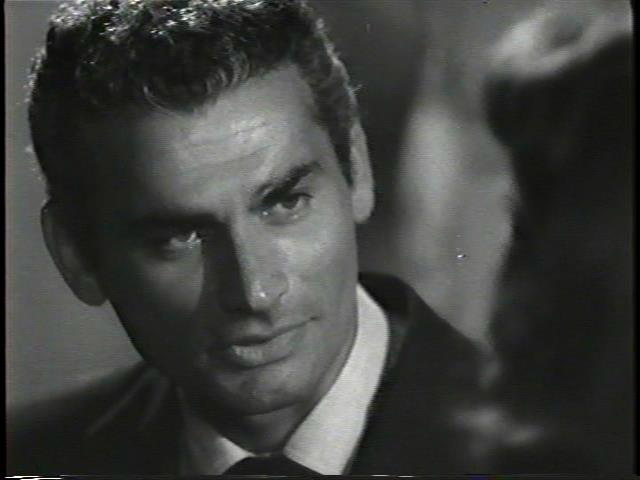 |
| Jeff Chandler gives one of his best performances |
Flashy Christine Carroll (Loretta Young) is given a package by her fiance, Mike (Alex Nicol), and suddenly finds herself arrested and in jail despite her truthful protestations of innocence. She trains to be a nurse in prison and winds up ministering to a handsome vet named Steve Kimberly (Jeff Chandler), with whom she falls in love and vice versa. Her parole officer (Helen Wallace) warns her that Steve must be informed of her prison record before they can marry, so an apprehensive Christine manages to get around this, and a child soon follows. Then Mike comes back into her life and everything starts unraveling ... Because of You is an entertaining soap opera that soon becomes a study of frustrated mother love, with good performances from Young (in a Joan Crawford-type role) and Chandler, who is at his best in this. Notable supporting players include Alexander Scourby as a doctor at the veteran's hospital; Frances Dee as Steve's lovely sister, Susan; Lynne Roberts as his friend, Rosemary; Gayle Reed as little Kim; and Arthur Space as a judge. Pevny also directed Chandler in Female on the Beach and Foxfire.
Verdict: Pleasant enough if unremarkable soaper with two solid lead performances. **1/2.
 |
| Joseph Cotten and Joan Fontaine |
When their plane to New York touches down near Naples for repairs, two strangers -- businessman David (Joseph Cotten) and concert pianist Manina (Joan Fontaine) -- decide to use the time to go sightseeing together, but miss their plane. They decide to continue sightseeing, then learn that the plane they were supposed to be on crashed, killing everyone aboard -- and they are listed in the paper as two of the victims. Unable to get a divorce from his wife, Catherine (Jessica Tandy), David importunes Manina to start a new life with him in Florence, where they rent or buy a villa with the aid of her teacher, Maria (Francoise Rosay). But will this merely be a brief if intense affair, and will the pull of the past prove too much to them?
A major problem with September Affair is the reaction the couple has to the news about the plane crash. They were on the plane, saw the passengers and some of the crew members, yet they never express the slightest pity for these people and their awful deaths, making them seem remarkably callous and self-absorbed. The plane crash and the deaths of over thirty people are simply an "opportunity" for these two losers. The shame of it is that just a brief moment of scripted compassion on their part would have made them more sympathetic and human. A bigger shame is that otherwise September Affair is not a terrible picture, although in the manner of soap operas it ignores certain realities such as remains and making a living. David writes Maria a check so she can cash it for him [considering the size of their palazzo it must have been a mighty sizable check], but he does it two days before the plane crash, making him seem positively prescient [or the check was post-dated].
On the plus side, Cotten and Fontaine, especially the latter, give very good performances, and Jessica Tandy [Adventures of a Young Man] nearly steals the picture as the confused, grieving wife. Robert Arthur also makes a positive impression as David's handsome, sensitive son [David is a selfish and terrible father, however.] The movie is drenched in romantic music, everything from "September Song" from Knickerbocker Holiday [an unofficial theme of the movie] to Rachmaninoff's Second Piano Concerto, which Manina plays in a concert. There are some beautiful Italian settings as well. A nice surprise is the appearance of Jimmy Lydon (Henry Aldrich) as a soldier in a restaurant who betrays a very pleasant voice when he sings "September Song" as Manina plays the piano. The frankly absurd ending seems forced by the production code of the period. William Dieterle also directed Love Letters with Joseph Cotten and many other movies.
Verdict: Lush and classy soap opera in many respects, but with a key flaw, confused and superficial script, and characters you sometimes may find it hard to root for. **1/2.
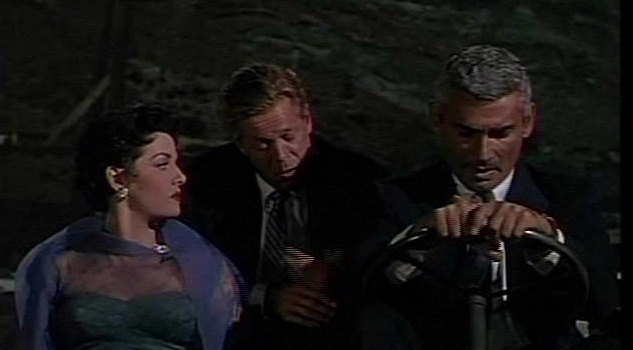 |
| Jane Russell, Dan Duryea and Jeff Chandler |
A wealthy young woman named Amanda (Jane Russell) gets a lift from a handsome half-Apache mining engineer [who seems to have mixed emotions about his heritage], Jonathan "Dart" Dartland (Jeff Chandler), and the two rapidly fall in love and get married. Amanda must deal with the culture shock of moving out of luxury to a comparative shack in a mining town, and Dart has to deal with jealousy and a certain void in his emotions, as well as some self-esteem issues. The movie doesn't bang you on the head with the characters' problems, which is all the better, and the leads give good performances. Chandler has a limited bag of tricks but he makes them work within the role, and Jane gives a vital, warm and appealingly feminine performance instead of playing it hooker-hard as she often does in other movies. She and Chandler work up a lot of chemistry, which the latter didn't have with all of his leading ladies [such as the unfortunate June Allyson]. Frieda Inescort [The Alligator People] is fine as Russell's high society mother, but Austrian Celia Lovksy is ludicrously miscast as Dart's Native American mother, especially with that thick Viennese accent! Dan Duryea scores as the alcoholic doctor in the mining camp as does Mara Corday as his nurse, Maria, even if it makes no sense that the doc is smitten with Amanda but can't see the even more gorgeous and buxom Maria for dust. "Foxfire" refers to an abandoned Indian mine that Dart suspects has hidden gold in it, and wants to work. When all is said and done, however, Foxfire can't quite rise above its minor melodrama-romance status, despite some unusual and interesting elements. Whether Foxfire is accurate as regards to Native American affairs and attitudes in the fifties is debatable. NOTE: Jeff Chander wrote the lyrics for the title tune (with music by Henry Mancini) and also did the vocal, quite creditably. Nice score by Frank Skinner.
Verdict: Nice technicolor and a solid cast never hurt. **1/2.
 |
| Allyson and Chandler at the sideshow |
A STRANGER IN MY ARMS (1959). Director: Helmut Kautner.
Korean war widow Christina Beasley (June Allyson) and her mother-in-law Virgilnie (Mary Astor) are both mourning the death of son and husband, Donald (Peter Graves). The women, especially Virgilnie, are hoping that Major Pike Yarnell (Jeff Chander) will use his influence to get Donald a posthumous Medal of Honor, even though it's given in only the most extreme of circumstances. At first Pike doesn't even want to come to a ceremony for the man who was his navigator, but his attraction to widow Christina gets the better of him. As Pike and Chris find themselves increasingly drawn to one another, Chris must face the reality of her marriage, and Virgilnie must confront the even more difficult reality of her relationship with her son, as well as what happened on the life raft that Pike and Donald shared in the days before Donald's death (shown in flashback). A Stranger in My Arms certainly sets up an intriguing situation, but it's still rather dull, and as a romance it misfires because the leads have no chemistry. Not only is the sexless Allyson a mismatch for the virile Chandler, but she's so short next to him that there are times you get the strange sensation that Pike is pitching woo to a circus midget [not that there's anything wrong with that]! Allyson and Chandler offer competent performances, but nothing more than that, leaving the acting honors to Mary Astor, who has an especially good scene reacting to a note left for her by her son. As Donald's bimbo sister, Sandra Dee seems like a moron. Charles Coburn plays Donald's wealthy grandfather, who thinks he can buy anything, even a medal; he's fine but appears too briefly. Conrad Nagel is suitably low-key as Astor's put-upon husband and Graves is adequate but unimpressive in the flashbacks on the life raft. Kautner did a few American films and then went back to Germany.
Verdict: Intriguing situations of which the most is not made. **1/2.
 |
| Barbara Stanwyck and Gene Reynolds |
Shelby Wyatt (Barbara Stanwyck) works for the wealthy "Nicko" Nicholas (Genevieve Tobin), riding her show horses, but her job comes to an end when she falls for Johnny (Gene Raymond of The Locket), who also works for Nicko, riding her polo ponies -- seems Nicko has a yen for Johnny herself. Soon the couple are out of work and struggling to survive as young marrieds. There are other complications, such as Shelby's snobbish in-laws and efforts by Nicko to get Johnny back. The cast helps keep the mediocre film reasonably entertaining, with Stanwyck as excellent as ever, and Tobin, Dorothy Tree [The Family Secret], Ann Shoemaker [House by the River], and especially John Eldredge (as another man in love with Shelby) offering up fine support. One big disappointment is that Shelby never gives Nicko the big whack she deserves.
Verdict: Another Stanwyck film in which she's much better than the material. **1/2.

Drummer: "How do you like your coffee?"
Lynn: "Alone!"
Wealthy widow Lynn Markham (Joan Crawford) moves into a beautiful beach house her husband owned that had formerly been leased to another wealthy widow, Eloise Crandell (Judith Evelyn). Eloise took a header off the deck onto the rocks below, and homicide is suspected, and the chief suspect is a handsome hustler named Drummer (Jeff Chandler), who has now set his sights on Lynn. Drummer has two sleazy associates who pretend to be his aunt and uncle, Osbert (Cecil Kellaway) and Queenie (Natalie Schafer), but Lynn gives the both of them a good dressing down. Unfortunately, Drummer has something the other two don't have, and that's sex appeal, so Lynn finds herself falling for the guy despite her better instincts. But has she stepped out of the frying pan into the fire? Female on the Beach has a workable premise and some good dialogue, but something's missing, and that's veracity and in-depth characterization. As essayed by Crawford, Lynn seems too smart not to walk away from Drummer when he says things like "I don't hate woman -- I just hate the way they are." True, it takes him some time to wear away her resistance, with her telling him initially "You're about as friendly as a suction pump!" The two leads aren't bad, although in some of their scenes talking of the past they seem like college students in an acting class. Kellaway [The Beast from 20,000 Fathoms] and Schafer [Repeat Performance] are fine, as is Jan Sterling [Johnny Belinda] as a real estate lady and former flame of Drummer's. Evelyn [Rear Window] makes an impression despite her limited screen time -- the opening and a couple of flashbacks. Charles Drake shows up now and then as a cop investigating Eloise's suspicious death [one has to wonder how such a tiny, frail thing as Evelyn could cause such damage to a wooden railing even if she were jet-propelled through it?] Female on the Beach is somewhat entertaining, but it's cheap, tawdry, and often unbelievable. Pevney also directed Man of a Thousand Faces with James Cagney. As an actor he appeared in such films as Body and Soul.
Verdict: Flaccid suspenser. **1/2.
 |
| Virginia Maskell and Ian McShane |
YOUNG AND WILLING aka The Wild and the Willing/1962). Director: Ralph Thomas.
"Damn it woman! Lloyds doesn't underwrite everything in life!"
Harry Brown (Ian McShane in his film debut) is a charismatic ladies man at an English college who has a steady girl, Josie (Samantha Eggar of Curtains), but has an affair with the wife, Virginia (Virginia Maskell), of one of his professors, the rather stern Chown (Paul Rogers). Harry is kind to his somewhat geeky roommate, Phil (John Hurt of Alien), and friendly with what appears to be the sole black student on campus, Reggie (Johnny Sekka). Other characters include Sarah (Katherine Woodwille), for whom Phil is carrying a torch, and somewhat snooty Andrew (Jeremy Brett), who was also involved with Virginia. It all leads up to a protracted finale in which Harry gets Phil to help him climb a tower and plant a flag as a prank, an act that leads to tragedy. Young and Willing has its moments, but a lot of it is very predictable. However, the actors are quite good, especially McShane and Maskell, here playing a role very different from hers in Doctor in Love, which was also directed by Ralph Thomas.
Verdict: Some compelling moments and performances. **1/2.

"This is just a question -- not the bell for the next round." -- Laura
"What are you doing here? You belong on an island with nobody on it." -- ditto
Laura with no last name, the oldest fashion model in the world (Esther Williams was nearing forty when she made this film) is in Rome when she gets a visit from her married lover's lawyer, Wally Drucker (Carlos Thompson). She decides to return home with him in his plane, but they make a crash landing on a small island located near Sardinia. The only inhabitants of the island are Urbano (Eduardo De Filippo) and his daughter, Costanza (Rossana Podesta), who is betrothed to a strange man named Moore (Jeff Chandler), who came to the island seeking peace and isolation and never left. As Laura and Wally try to fix up a yacht to take them off the island, Laura and Moore find themselves attracted, even as strange acts of sabotage occur on the boat, and Costanza's handsome ex-lover, Gavino (Rik Battaglia), shows up now and then in his rowboat gunning for Moore. Laura makes up her mind to find out exactly who "Moore" is and where he came from. If you think this movie might be interesting, be forewarned that it's not a fraction as entertaining as it sounds. There's a lot of empty posturing with no substance underneath, hollow, under-written characters, and lead actors who are competent but completely miscast. While there's what passes for smouldering passion between Laura and Moore, and Wally seems hot for everyone, the movie has an erotic charge that registers zero. With more than one climax, it seems to take forever to finally end. Thompson seems to have been dubbed by Paul Frees, and the pseudo-romantic music, some of which is nice, is by Hans Salter. Wilson also directed The Big Boodle with Errol Flynn.
Verdict: The only memorable thing about this tedious mess is the title. *1/2.
 |
| Keith Andes and Angela Lansbury |
An out-of-work architect named Edward Shaw (Keith Andes) is given an attractive business proposal by wealthy Doris Hillman (Angela Lansbury) and her older husband, Gus (Douglass Dumbrille). The catch is that Shaw will have to be insured for a very large sum of money, with Gus being the beneficiary. Shaw's paranoia over this aspect of the alliance only increases when he is drawn into a romance with Doris, and can't tell if she really loves him or is just waiting for hubby to collect on the insurance. Then there are the suspicious "accidents" ... Andes [Clash By Night] makes a compelling, if understandably grumpy, leading man, and Dumbrille [Mr. Deeds Goes to Town] is typically excellent. Lansbury [Please Murder Me] gives a good performance as well, but while attractive, she is not quite convincing as the sexy, femme fatale type. [Ironically, a less talented "B" actress probably could have filled the bill better.] Jane Darwell is fine if a bit wasted as a landlady. A Life at Stake holds the attention and is not entirely predictable.
Verdict: Watch out for spiked coffee! **1/2.
 |
| Isabel Jewell and Regis Toomey |
Sally Bates (Isabel Jewell) makes her way to Hollywood and a hopefully better life, but would have wound up sleeping in her car were it not for the kindness of Bill Cutler (Buster Crabbe), who runs a food stand with his mother (Maidel Turner of State of the Union). Bill develops feelings for Sally, although he already has a girlfriend in wealthy, snooty Clara (Sally Blane). However he has a rival for Sally's affections in Jack Berry (Regis Toomey of Shopworn), who loves to drink and party. In the meantime, Bill's mother turns out not to be quite as nice as she at first seems. Jewell [The Seventh Victim] is an appealing performer, the other cast members are fine, but She Had to Choose becomes increasingly ridiculous and melodramatic. The funniest scene -- intended to be dramatic -- is when Sally rips off a dress she is wearing [unbeknownst to her it belongs to Clara] after an altercation and runs out of a nightclub in her slip. And things get more ridiculous after that! One assumes the title has to do with which man Sally will choose, as she really isn't given any other "choices" in the movie.
Verdict: Don't choose this movie. *1/2.
 |
| Unlikely coupling: Maria Schneider and Marlon Brando |
"I'll be smirking and giggling all the way to eternity."
Jeanne (Maria Schneider), a young woman whose boyfriend, Tom, is filming a documentary about her life as it happens, enters into a "no names," no frills affair with an older man, Paul (Marlon Brando of On the Waterfront), whose wife has just committed suicide. Tom (Jean-Pierre Leaud) is unaware of Paul and his girlfriend's sexual obsession with the man. Will the two lovers manage to keep things casual, or will one of the participants want something more than just the eroticism? Last Tango in Paris was heavily promoted as an "art film" -- an Italian director and set in Paris! -- with screenings only in certain New York theaters and with tickets sold in advance with assigned seats. Without the frank sexual activity -- a sodomy scene with butter was especially notorious -- it's unlikely anyone but Bertolucci's most fervent admirers would have cared about this fairly dull movie. The film is pretentious and all over the lot, as if Bertolucci had cobbled a screenplay around Brando and Paris and hoped for the best -- a series of tableau's that never really jell, although there are some interesting bits and pieces along the way, and the film does get at certain truths in some relationships where there is a distinct age difference between the parties. Some scenes seem thrown in because they might seem unique -- Paul has a talk with his dead wife's lover, Marcel (Massimo Girotti) for instance -- but they don't convince, just as it's hard to ever take seriously the "relationship" between Jeanne and Paul. [After passing on the street, they meet when both look at an apartment for rent, but there is nothing to suggest an attraction between the two. Yet Paul simply picks Jeanne up and begins having sex with her without her protesting.] Another senseless scene has Paul chasing after a potential client of a hooker who has changed his mind and calling him a "faggot." There is some humor on the sophomoric side -- Paul moons an older woman at a Tango palace -- and the performances aren't bad, but the actors have no fully dimensional characters to play, and Paul is essentially an asshole. Ultimately what Tango seems to be about is an aging, bitter man objectifying and debasing a younger woman even as she exposes how pathetic he is. Scheider appeared in quite a few movies both before and after Tango.
Verdict: Like La Luna this is another Bertolucci movie that may make you want to say yuck! **.

Dancer Kathy O'Connor (Sally Rand) is determined to get the man who ordered her cop father's death, and comes up with a rather implausible plan. She will go to Europe, develop a reputation as the Toast of the Continent under the name "Valerie," and come back to the US to work in a night club owned by bad guy Stephani (Paul Sutton), whereupon she will get the goods on him. Two men are vying for her favors: Detective Helton (Reed Hadley), who had worked with her father; and reporter Lou Fleming (Dennis Moore), who has feelings for Kathy but may have to make do with the slightly pixelated singer, Penny Nichols (Kathryn "Sugar" Kane). Sally Rand made quite a few movies before this, including many silents, but Sunset was her last picture. She became more famous as a burlesque performer with a famous fan dance than as an actress. There's a funny scene when Helton registers his disapproval of dancer Kathy without realizing she's the daughter of his partner. Rand is cute and likable, but Dennis Moore [The Fearmakers] makes the biggest impression as Lou, giving a fine performance of charm and humor. Orchestra leader Henry King plays himself. Handsome Hadley made more of an impression as the lead in the classic serial Zorro's Fighting Legion.
Verdict: Easygoing vehicle for Rand with a potpourri of a script. **.